How AI is expanding
what people do at work
Economic Research’s new Work at the Frontier series shows how workers cross over into work beyond the traditional boundaries of their roles.
AI changes the work that people do. In an analysis of more than 800,000 messages from U.S. ChatGPT users, our new research suggests that 16.8% of work-related messages and 43.5% of occupation-specific messages are about tasks associated with another occupation.
A small-business owner can independently draft copy, review a contract, or perform basic financial analysis. A salesperson can use AI to explore a customer dataset that might once have gone to an analyst. A marketer can troubleshoot a website without waiting for a developer. In each case, AI changes not just how work gets done, but who does what.
Our new report, Work at the Frontier: How AI is Expanding What People Do at Work, studies this shift. We call the resulting pattern task crossover: work historically associated with one occupation appearing in the AI use of people in another. In our AI Jobs Transition Framework(opens in a new window), we argue that many jobs are likely to reorganize: these are jobs whose day-to-day tasks could change substantially. This report is the first in our new Work at the Frontier series, which explores how AI is changing work in real time.
Using our unique window into how the world of work is changing, we will offer regular data-driven insights based on evidence to guide policy and practice.
Nearly half of occupation-specific AI use crosses job boundaries
Many studies of AI and work begin with a fixed list of tasks associated with a given occupation and ask whether models can perform them. Our evidence suggests that AI is also changing who takes on which tasks.
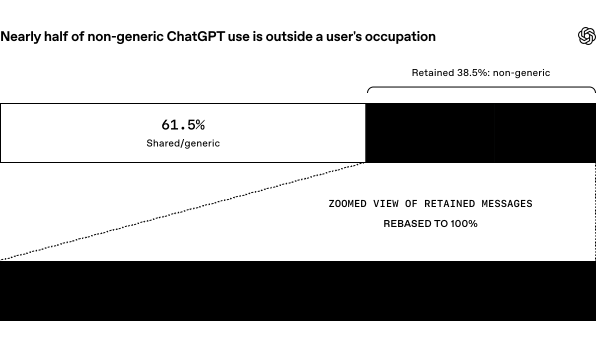
To measure task crossover, we first separate work that is associated with an occupation from work that appears across many jobs. Some activities, such as writing, summarizing, and scheduling, are shared too broadly across occupations to be evidence of crossover. We classify these as generic. For the remaining messages, we ask whether the task falls inside or outside the user’s own occupation. Among non-generic messages, 43.5% fall outside of the user’s occupation, offering an early window into how AI may be reshaping the task content of jobs before those changes appear in job descriptions or titles.
This suggests that a substantial part of work-related ChatGPT use is from users expanding their role. The pattern is especially pronounced in several groups. Once generic work is excluded, outside-occupation tasks account for:
- 77% of occupation-specific messages from customer experience workers
- 75% from designers
- 69% from human resources workers
- 56% from legal workers
- 53% from marketers
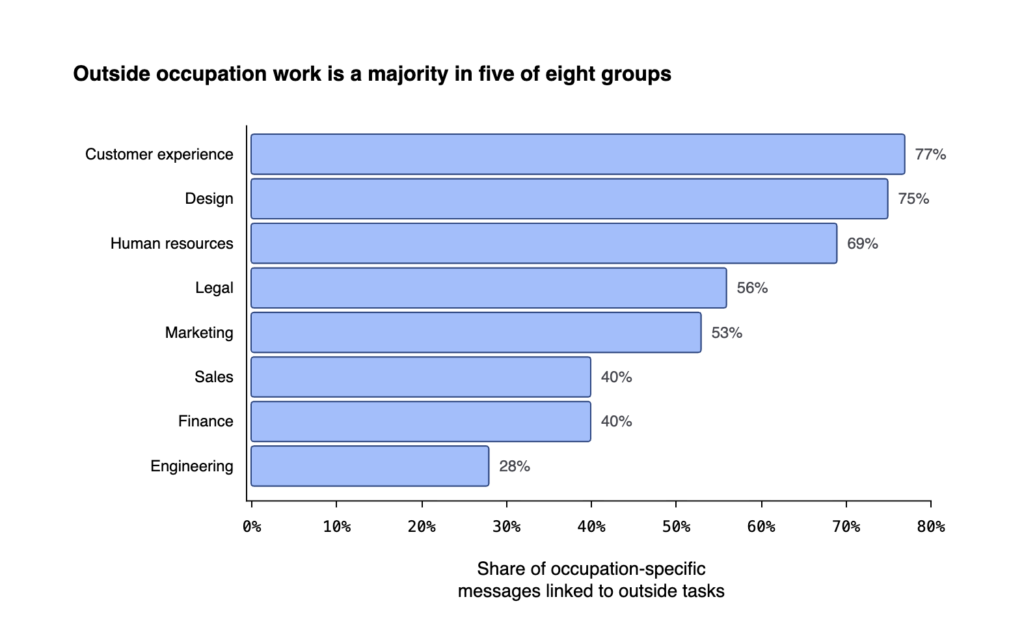
These occupations are “borrowing” these tasks from other roles. The evidence points to a changing division of work: some activities that once required a handoff can now be done by the person who first encounters the need.
Some tasks travel farther than others
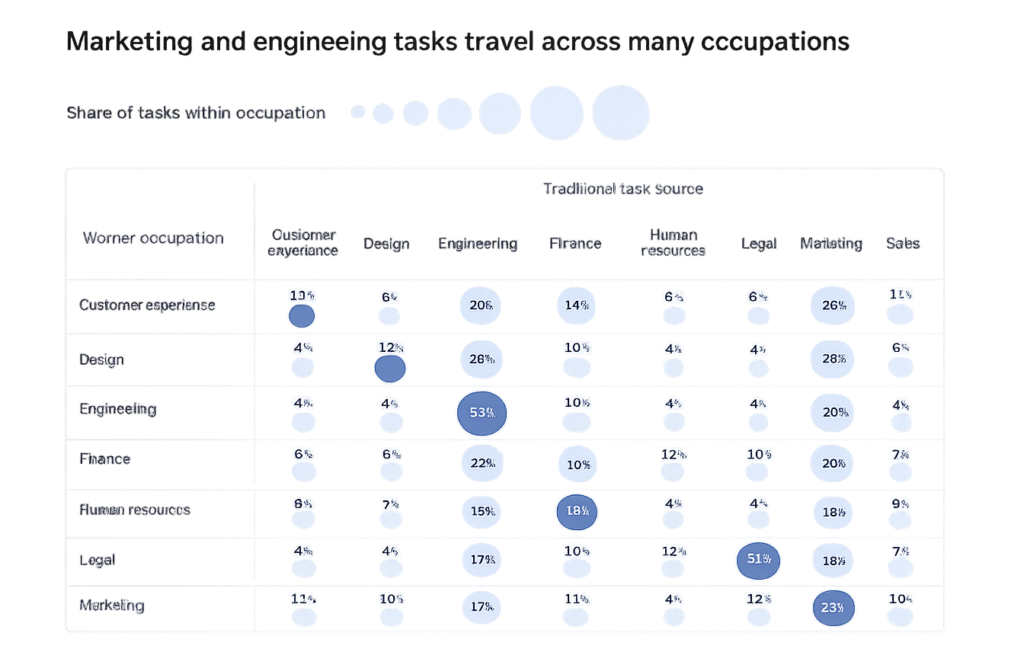
The heatmap below shows task crossover by asking which occupation’s job each non-generic message most closely resembles. Marketing and engineering tasks travel farthest, frequently showing up in messages from workers outside those fields.
More task crossover in small businesses
The size and structure of a business shapes how AI changes work. In a large company, employees may have access to specialized teams, established workflows, and internal services. In a smaller organization, the worker closest to the problem is more likely to take on the problem rather than delegate.
Among average users, the outside-occupation task share falls from 18.9% for users in workspaces with 2–5 seats to 16.3% for users in workspaces with over 100 seats. Among the heaviest users, we do not see the same monotonic pattern.
One possible explanation is that moderate users in smaller organizations turn to AI when they encounter work that would otherwise require another function. Heavy users may instead have developed stable AI-supported workflows that look more similar across organizations, or may use AI more intensively within their core occupation.
AI may be especially useful as a generalist tool where specialist resources are scarce.