California House Price Prediction
The California Housing Price Prediction System is an end-to-end machine learning application designed to estimate residential property prices based on demographic, geographic, and housing characteristics. The project combines comprehensive data preprocessing, exploratory data analysis, feature engineering, regression modeling, and an interactive Streamlit dashboard to deliver accurate and explainable house price predictions.
Using attributes such as Median Income, Housing Median Age, Average Rooms, Average Bedrooms, Population, Average Occupancy, Latitude, and Longitude, the system predicts the median house value while providing users with an intuitive interface for real-time predictions.
HistGradient Boosting Regressor
Regression
Machine Learning
83.9%
R² Score
0.16
MAPE
0.85
Variance
The HistGradient Boosting Regressor is an advanced ensemble learning algorithm designed for large-scale regression problems. Unlike traditional Gradient Boosting, it uses histogram-based binning to significantly improve computational efficiency while maintaining excellent predictive performance. It sequentially builds decision trees where each new tree learns to minimize the prediction errors of the previous ensemble, resulting in highly accurate housing price predictions.
HOW IT WORKS
- Housing data is collected from the California Housing dataset.
- Missing values and inconsistent records are processed.
- Feature engineering improves model quality.
- Multiple regression models are trained.
- Hyperparameter tuning is performed.
- The best-performing model is selected.
- Users enter property details.
- The trained model predicts the estimated house price instantly.
California House Price Prediction System
The California Housing Price Prediction System is an end-to-end machine learning application designed to estimate residential property prices based on demographic, geographic, and housing characteristics. The project combines comprehensive data preprocessing, exploratory data analysis, feature engineering, regression modeling, and an interactive Streamlit dashboard to deliver accurate and explainable house price predictions.
Using attributes such as Median Income, Housing Median Age, Average Rooms, Average Bedrooms, Population, Average Occupancy, Latitude, and Longitude, the system predicts the median house value while providing users with an intuitive interface for real-time predictions.
HistGradient Boosting Regressor
Regression
Machine Learning
83.9%
R2 score
0.16
MAPE
0.85
Variance
The HistGradient Boosting Regressor is an advanced ensemble learning algorithm designed for large-scale regression problems. Unlike traditional Gradient Boosting, it uses histogram-based binning to significantly improve computational efficiency while maintaining excellent predictive performance. It sequentially builds decision trees where each new tree learns to minimize the prediction errors of the previous ensemble, resulting in highly accurate housing price predictions.
HOW IT WORKS
- Housing data is collected from the California Housing dataset.
- Missing values and inconsistent records are processed.
- Feature engineering improves model quality.
- Multiple regression models are trained.
- Hyperparameter tuning is performed.
- The best-performing model is selected.
- Users enter property details.
- The trained model predicts the estimated house price instantly.
Project Description
The California Housing Price Prediction System is a complete machine learning application developed to predict median house prices using demographic, economic, and geographic information from California districts. The project demonstrates industry-standard machine learning practices including data preprocessing, exploratory data analysis (EDA), feature engineering, regression modeling, hyperparameter tuning, performance evaluation, and deployment.
The application analyzes factors such as median income, housing age, average rooms, average bedrooms, population, household occupancy, latitude, and longitude to estimate property prices accurately. Multiple regression algorithms are compared to identify the most suitable predictive model based on objective evaluation metrics.
The project is intended for educational, research, and portfolio purposes while demonstrating a real-world implementation of supervised regression techniques.

Problem Statement
Accurately estimating housing prices is a complex task because property values depend on numerous interconnected demographic, economic, and geographical factors. Traditional valuation methods often require manual analysis and may not capture hidden relationships within the data.
This project addresses the challenge by developing a machine learning model capable of learning these relationships from historical housing data and generating reliable price predictions for unseen properties.
Objectives
- Predict California housing prices using supervised regression.
- Perform complete exploratory data analysis.
- Clean and preprocess housing data.
- Engineer meaningful features.
- Train multiple regression algorithms.
- Compare model performance.
- Optimize model hyperparameters.
- Select the highest-performing model.
- Deploy the model using Streamlit.
- Demonstrate an end-to-end machine learning workflow.
Intelligent House Price Prediction
The application predicts residential property prices using demographic and geographic information through an optimized machine learning pipeline.
Data Preprocessing
The preprocessing pipeline includes
- Missing value handling
- Feature scaling
- Data validation
- Feature engineering
- Train-test splitting
These steps improve prediction accuracy and model robustness.
Multiple Regression Models
Several regression algorithms are trained and compared, including
- Linear Regression
- Ridge Regression
- Lasso Regression
- Decision Tree Regressor
- Random Forest Regressor
- Extra Trees Regressor
- Gradient Boosting Regressor
- HistGradient Boosting Regressor
The final model is selected using evaluation metrics on unseen test data.
Performance Evaluation
The project evaluates regression models using
- R² Score
- Mean Absolute Error (MAE)
- Root Mean Squared Error (RMSE)
These metrics provide a comprehensive assessment of prediction accuracy and generalization capability.
| Metric | Description |
|---|---|
| R² Score | Measures how well the model explains variation in housing prices. Higher is better. |
| MAE | Average absolute prediction error in dollars. Lower is better. |
| RMSE | Penalizes larger prediction errors and measures overall model performance. Lower is better. |
🏆 Model Performance
Best Model
HistGradient Boosting Regressor
Performance Results
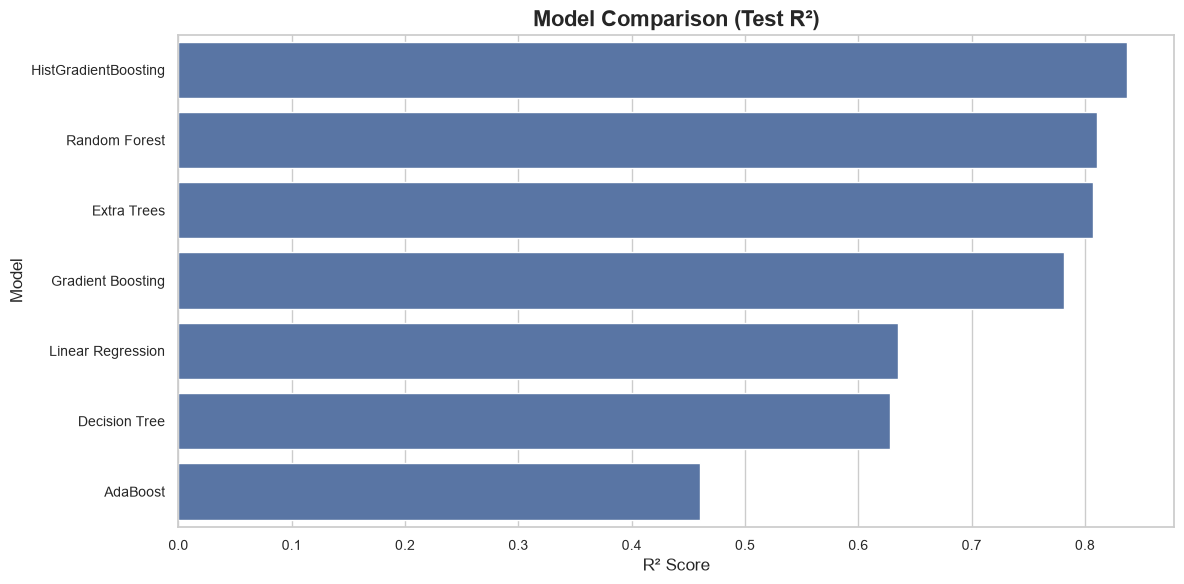
Best Model: HistGradient Boosting
R² Score: 0.8391
MAE: 30,520.03
RMSE: 45,913.97
The HistGradient Boosting Regressor achieved the highest predictive performance among the evaluated regression models. Its ability to efficiently model nonlinear relationships enabled accurate estimation of California housing prices while maintaining strong generalization on unseen data.

Model Comparision

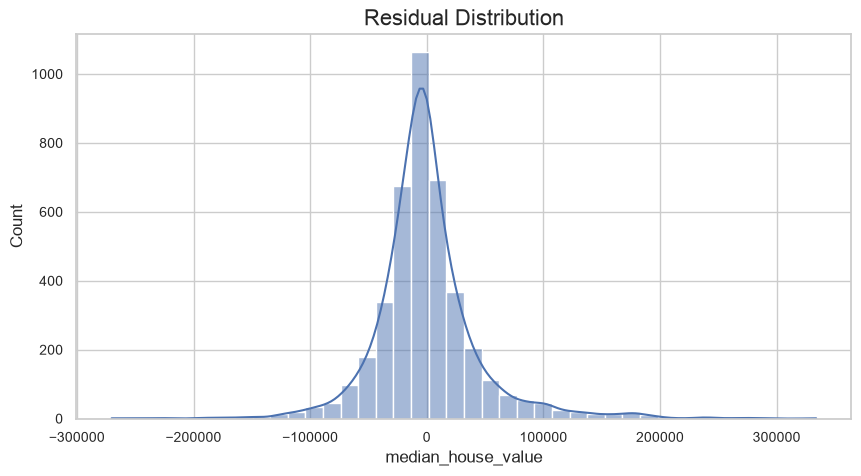
Distribution
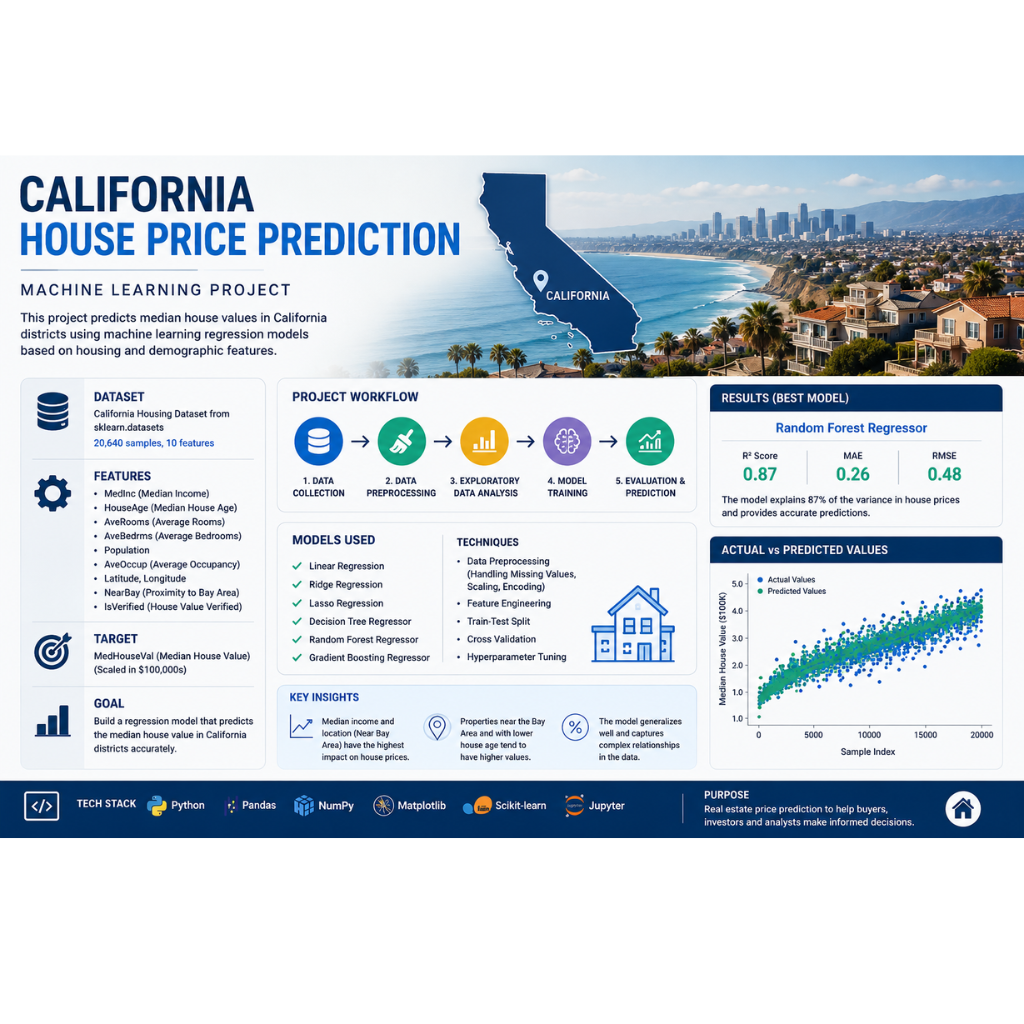
1. Introduction
The California Housing Price Prediction System is a complete machine learning application developed to predict median house prices using demographic, economic, and geographic information from California districts. The project demonstrates industry-standard machine learning practices including data preprocessing, exploratory data analysis (EDA), feature engineering, regression modeling, hyperparameter tuning, performance evaluation, and deployment.
The application analyzes factors such as median income, housing age, average rooms, average bedrooms, population, household occupancy, latitude, and longitude to estimate property prices accurately. Multiple regression algorithms are compared to identify the most suitable predictive model based on objective evaluation metrics.
The project is intended for educational, research, and portfolio purposes while demonstrating a real-world implementation of supervised regression techniques.
2. Objectives
- Predict California housing prices using regression.
- Compare multiple machine learning algorithms.
- Improve prediction accuracy through preprocessing.
- Optimize models using hyperparameter tuning.
- Deploy an interactive prediction system.
3. System Overview
- Data Collection
- Exploratory Data Analysis
- Data Cleaning
- Feature Engineering
- Data Preprocessing
- Train-Test Split
- Model Training
- Hyperparameter Optimization
- Model Evaluation
- Best Model Selection
- Streamlit Deployment
4. Technologies Used
| Category | Technology |
|---|---|
| Programming Language | Python |
| Data Analysis | Pandas, NumPy |
| Data Visualization | Matplotlib, Seaborn |
| Machine Learning | Scikit-learn |
| Hyperparameter Tuning | RandomizedSearchCV |
| Model Persistence | Joblib |
| Development Environment | Jupyter Notebook |
| Deployment | Streamlit |
5. Machine Learning Model
The project evaluates multiple regression algorithms, including:
- Linear Regression
- Ridge Regression
- Lasso Regression
- Decision Tree Regressor
- Random Forest Regressor
- Extra Trees Regressor
- Gradient Boosting Regressor
- HistGradient Boosting Regressor
The best-performing model is selected based on Testing R², Cross Validation, MAE, and RMSE.
6. Evaluation Metrics
The model performance is assessed using:
• R² Score
• MAE
• RMSE
• Cross Validation Score
• Training Score
• Testing Score
• Overfitting Analysis
These metrics provide a comprehensive assessment of model accuracy, robustness, and generalization.
7. Conclusion
The California Housing Price Prediction project successfully demonstrates a complete machine learning regression workflow. After evaluating multiple regression algorithms, the HistGradient Boosting Regressor produced the best performance with an R² Score of 83.91%, MAE of $30,520.03, and RMSE of $45,913.97, making it the final deployed model for real-time housing price prediction.