


Spam Detection System
The AI Email & SMS Spam Detection System is a machine learning-based web application designed to automatically classify incoming email or SMS messages as Spam or Safe (Ham). The system analyzes the text of a message using Natural Language Processing (NLP) techniques and predicts whether the content is legitimate or potentially harmful.
This project aims to help users identify phishing attempts, promotional spam, scam messages, fraudulent links, and other unwanted communications before interacting with them. By leveraging machine learning, the system provides fast, accurate, and reliable spam detection through a clean and user-friendly web interface.
SVM
NLP
Feature Extraction
Deep Learning
98%
Accuracy
97%
Precision
91%
F1 score
The Support Vector Machine (SVM) is a supervised machine learning algorithm widely used for both classification and regression tasks. In spam detection, SVM is primarily used as a binary classifier to determine whether a message belongs to the Spam or Safe (Ham) category.
Deep Learning is a subset of Artificial Intelligence (AI) and Machine Learning (ML) that uses Artificial Neural Networks (ANNs) with multiple hidden layers to automatically learn complex patterns from data. Unlike traditional machine learning algorithms that often require manual feature engineering, deep learning models can learn hierarchical representations directly from raw data.
Spam Detection System
The AI Email & SMS Spam Detection System is a machine learning-based web application designed to automatically classify incoming email or SMS messages as Spam or Safe (Ham). The system analyzes the text of a message using Natural Language Processing (NLP) techniques and predicts whether the content is legitimate or potentially harmful.
This project aims to help users identify phishing attempts, promotional spam, scam messages, fraudulent links, and other unwanted communications before interacting with them. By leveraging machine learning, the system provides fast, accurate, and reliable spam detection through a clean and user-friendly web interface.
SVM
NLP
Feature Extraction
Deep Learning
98%
Accuracy
97%
Precision
91%
F1 score
3
Models
The Support Vector Machine (SVM) is a supervised machine learning algorithm widely used for both classification and regression tasks. In spam detection, SVM is primarily used as a binary classifier to determine whether a message belongs to the Spam or Safe (Ham) category.
Deep Learning is a subset of Artificial Intelligence (AI) and Machine Learning (ML) that uses Artificial Neural Networks (ANNs) with multiple hidden layers to automatically learn complex patterns from data. Unlike traditional machine learning algorithms that often require manual feature engineering, deep learning models can learn hierarchical representations directly from raw data.
Project Description
The AI Email & SMS Spam Detection System is a machine learning-based web application designed to automatically classify incoming email or SMS messages as Spam or Safe (Ham). The system analyzes the text of a message using Natural Language Processing (NLP) techniques and predicts whether the content is legitimate or potentially harmful.
This project aims to help users identify phishing attempts, promotional spam, scam messages, fraudulent links, and other unwanted communications before interacting with them. By leveraging machine learning, the system provides fast, accurate, and reliable spam detection through a clean and user-friendly web interface.
The application is built with Python, Scikit-learn, NLTK, and Streamlit, allowing users to perform real-time message analysis directly from their web browser without installing any additional software.
Problem Statement
Every day, millions of users receive unwanted emails and SMS messages containing advertisements, phishing links, fake offers, financial scams, or malicious content. These spam messages waste time, reduce productivity, and may lead to identity theft or financial loss if users unknowingly interact with them.
Traditional rule-based spam filters often struggle to detect newly emerging spam patterns. Therefore, a machine learning approach is used to learn from historical spam data and accurately classify new, unseen messages.
Objectives
- Detect whether a message is Spam or Safe.
- Classify messages using a trained machine learning model.
- Provide prediction confidence scores.
- Display prediction history.
- Offer a simple and interactive web interface.
- Process text efficiently using Natural Language Processing.
- Deliver instant results with high prediction accuracy.
AI-Powered Spam Detection
The system employs an SVM machine learning algorithm that is coupled with NLP for automatic classification of spam emails and SMS into Spam and Safe categories. Prior to classification, the input text goes through various preprocessing steps which include text cleansing, tokenization, removing stop words and extraction of features using TF-IDF. Then the trained model analyses the text and gives a reliable prediction. This kind of artificial intelligence technology allows the system to detect spam, promotions, phishing, scams, and other types of unsolicited communications without human interference.
Real-Time Prediction
The tool has been designed to detect spam in real time using a web interface that uses Streamlit. All a user has to do is to input the email or SMS by pasting or typing it into the box and clicking on the Analyze Message button. The text is then processed and analyzed in no time at all, with the prediction being displayed almost immediately.
Confidence Score
Apart from showing the prediction result, the app shows a confidence score, which indicates how confident the machine learning algorithm is about its prediction. This confidence score is obtained based on the prediction probability returned by the machine learning classifier, and the same is shown as a percentage. If the confidence score is high, then it implies that the classifier is highly confident about its prediction. By showing the prediction along with the confidence score, the app ensures transparency in the process of decision-making.
User-Friendly Interface
The interface is designed with Streamlit and includes:
- Modern dashboard
- Clean responsive layout
- Interactive buttons
- Sidebar navigation
- Prediction cards
- Statistics section
- Confidence visualization
The trained models are evaluated using industry-standard classification metrics.
| Metric | Description |
|---|---|
| Accuracy | Measures the overall percentage of correctly classified transactions. |
| Precision | Indicates how many transactions predicted as fraudulent are actually fraudulent. |
| Recall | Measures the model’s ability to detect all fraudulent transactions. |
| ROC-AUC Score | Evaluates the model’s ability to distinguish between fraudulent and legitimate transactions across different thresholds. |
Problem Statement
Every day, millions of users receive unwanted emails and SMS messages containing advertisements, phishing links, fake offers, financial scams, or malicious content. These spam messages waste time, reduce productivity, and may lead to identity theft or financial loss if users unknowingly interact with them.
Traditional rule-based spam filters often struggle to detect newly emerging spam patterns. Therefore, a machine learning approach is used to learn from historical spam data and accurately classify new, unseen messages.
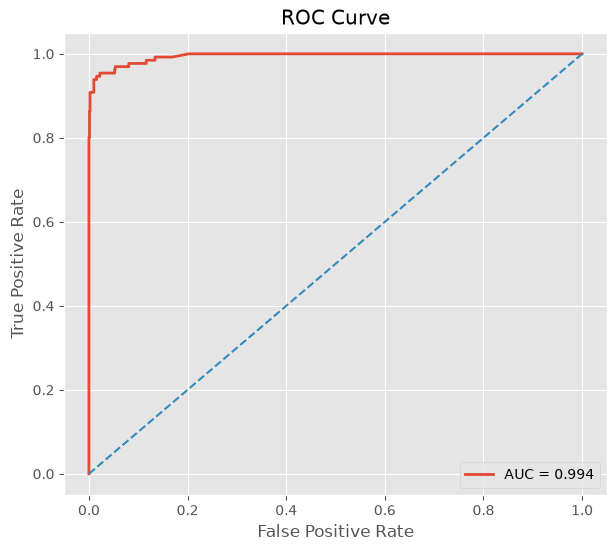
Roc Curve
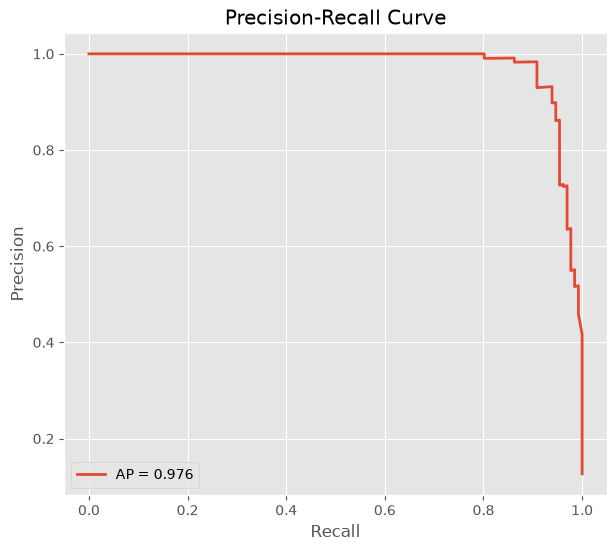
Precision - Recall
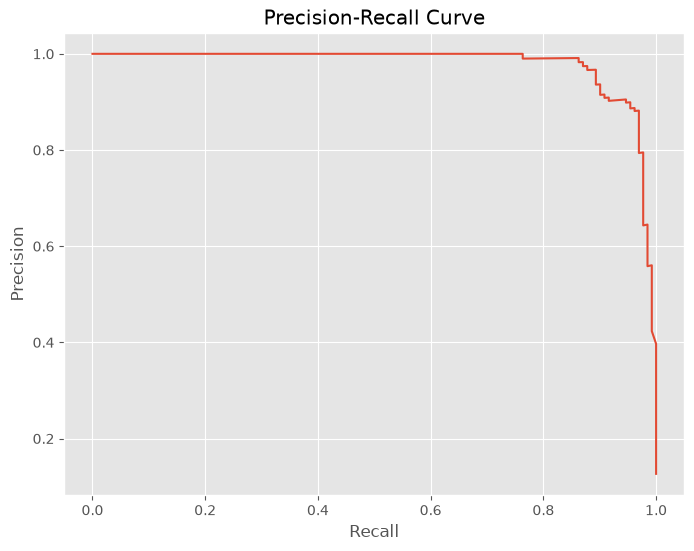
Precision
1. Introduction
The AI Email & SMS Spam Detection System is a machine learning-powered web application that automatically identifies whether an email or SMS message is Spam or Safe (Ham). The application uses Natural Language Processing (NLP) and a trained Support Vector Machine (SVM) model to analyze the content of text messages and classify them with high accuracy.
The project provides a modern and user-friendly interface developed using Streamlit, enabling users to paste messages and receive real-time predictions along with confidence scores. It aims to reduce the risks associated with phishing, fraudulent messages, promotional spam, and other unwanted communications.
2. Objectives
The primary objectives of this project are:
- Detect spam and legitimate messages automatically.
- Improve communication security using Artificial Intelligence.
- Provide fast and accurate real-time predictions.
- Reduce manual filtering of unwanted messages.
- Demonstrate the practical application of Machine Learning and NLP.
- Create an interactive and easy-to-use web application.
3. System Overview
The system follows a complete machine learning workflow that includes:
- Data Collection
- Data Preprocessing
- Feature Extraction
- Model Training
- Model Evaluation
- Model Deployment
- Real-Time Prediction
Users simply enter a message into the application, and the trained model predicts whether the message is Spam or Safe, displaying both the classification result and the confidence score.
4. Technologies Used
| Category | Technology |
|---|---|
| Programming Language | Python |
| Machine Learning | Scikit-learn |
| NLP Library | NLTK |
| Web Framework | Streamlit |
| Data Processing | Pandas, NumPy |
| Visualization | Plotly |
| Model Serialization | Pickle |
| Version Control | Git & GitHub |
| Deployment | Streamlit Community Cloud |
5. Machine Learning Model
The application uses a Support Vector Machine (SVM) classifier integrated into a Scikit-learn pipeline.
The pipeline performs:
- Text preprocessing
- TF-IDF Vectorization
- SVM Classification
SVM is particularly suitable for text classification because it performs exceptionally well with high-dimensional feature spaces created by TF-IDF vectors. The model learns the optimal decision boundary that separates spam and legitimate messages while maximizing the margin between classes, resulting in strong generalization on unseen data.
6. Natural Language Processing (NLP)
Before classification, every message undergoes preprocessing to improve prediction quality.
The preprocessing steps include:
- Converting text to lowercase
- Removing punctuation
- Removing numbers
- Removing URLs
- Removing special characters
- Tokenization
- Stop-word removal
- Stemming
The cleaned text is then transformed into numerical features using TF-IDF (Term Frequency–Inverse Document Frequency), allowing the machine learning model to analyze textual information effectively.
7. System Workflow
The application follows the workflow below:
- User enters an email or SMS message.
- The input text is cleaned and preprocessed.
- The TF-IDF vectorizer converts the text into numerical features.
- The trained SVM model predicts the message category.
- The application calculates prediction probabilities.
- The result is displayed as Spam or Safe.
- The prediction is stored in the session history for future reference.
8. Conclusion
- The artificial intelligence-based Email and SMS Spam Prevention Program is an example of the utilization of Machine Learning and Natural Language Processing for the improvement of security in online communication. The combination of TF-IDF extraction and the Support Vector Machine model makes possible the performance of efficient and precise spam detection in real time. The user-friendly Streamlit interface, the provided confidence scores and predictions’ history make the service perfect for educational goals and development of more sophisticated software solutions in spam filtering and protection fields.